In my last post, I showed a CostEnrichingSpanExporter that injects cost data into LLM spans. It works. But it mutates span._attributes, a private API that violates the OpenTelemetry spec. The ReadableSpan contract says spans are immutable after on_end(). The Python SDK’s _attributes happens to be a writable BoundedAttributes dict, but that’s an implementation detail, not a contract. GitHub issue #4424 explicitly requests hooks for this use case and confirms the gap.
What if cost enrichment happened in Elasticsearch, not in Python?
The Enrich Processor does exactly this: it performs a lookup join against a pricing index at ingest time, before the document is written. No span mutation, no SDK coupling, no redeployments when pricing changes. This post walks through the complete setup: a pricing index, an enrich policy, an ingest pipeline wired into traces-apm@custom, and the operational lifecycle for keeping prices current.
1. Why Server-Side Enrichment#
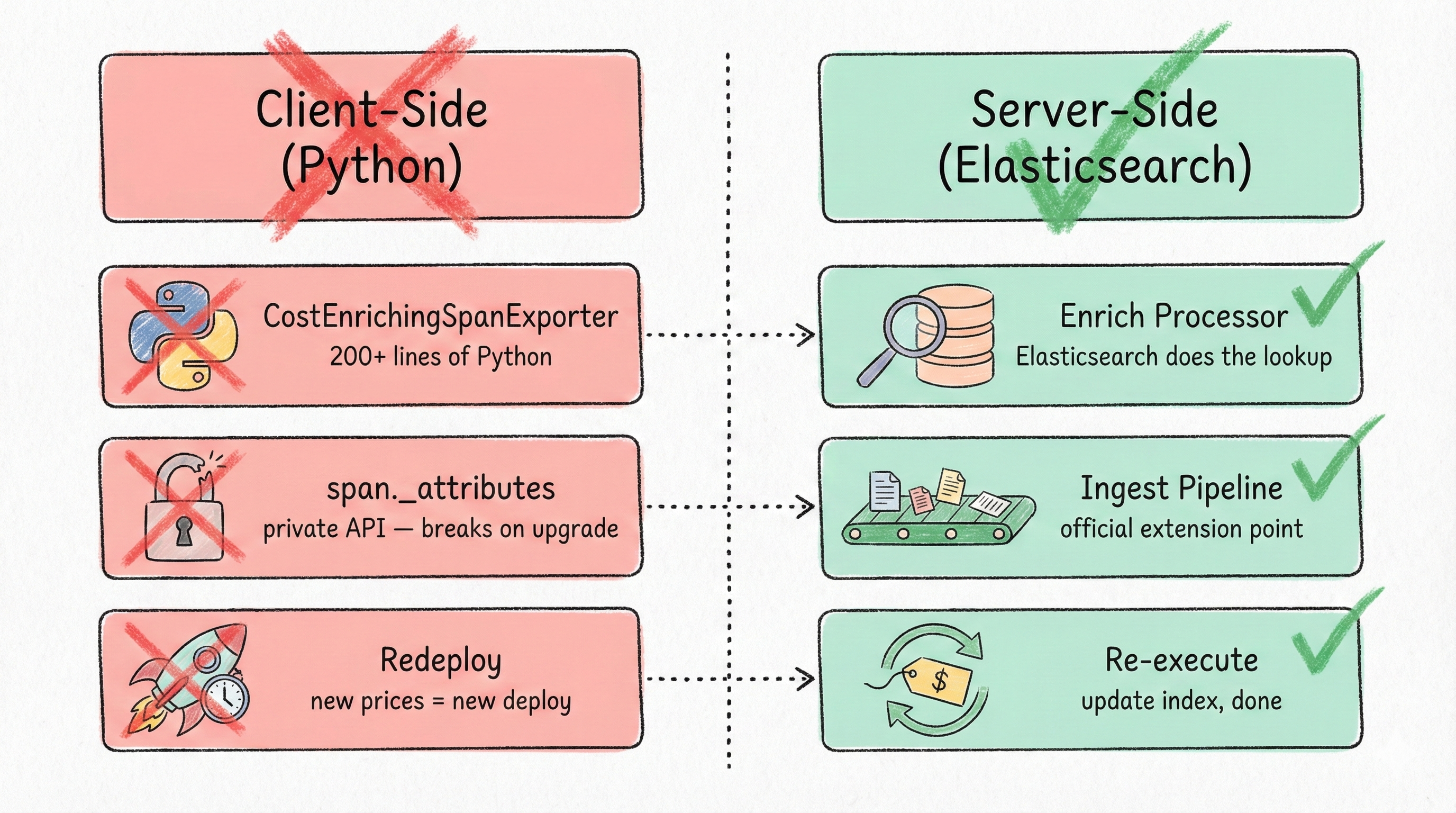
Before diving into the implementation, the tradeoff table below convinced me to make the switch:
| Factor | Client-Side (CostEnrichingSpanExporter) | Server-Side (Ingest Pipeline) |
|---|
| Span immutability | Violates ReadableSpan contract via private _attributes | No span mutation — enrichment happens in Elasticsearch |
| SDK version coupling | Breaks if BoundedAttributes internals change | Zero SDK dependency |
| Pricing updates | Requires redeploying all application services | Update source index + re-execute enrich policy |
| Retroactive cost fixes | Impossible — cost is baked in at export time | _update_by_query with the pipeline re-processes historical docs |
| Multi-language support | Must reimplement for every OTel SDK language | Works for any SDK sending to Elastic APM |
| Operational complexity | Simple Python, no ES config needed | Enrich policy + pipeline + scheduled re-execution |
| Latency impact | Microseconds at export time | Milliseconds at ingest time |
| Debugging | Print statements in Python | _simulate API with ?verbose |
The server-side approach is better for any team where (a) pricing changes, (b) multiple services emit LLM traces, or (c) you ever need to correct historical cost data. The client-side approach from the original post is still fine for quick prototyping.
2. The Architecture#
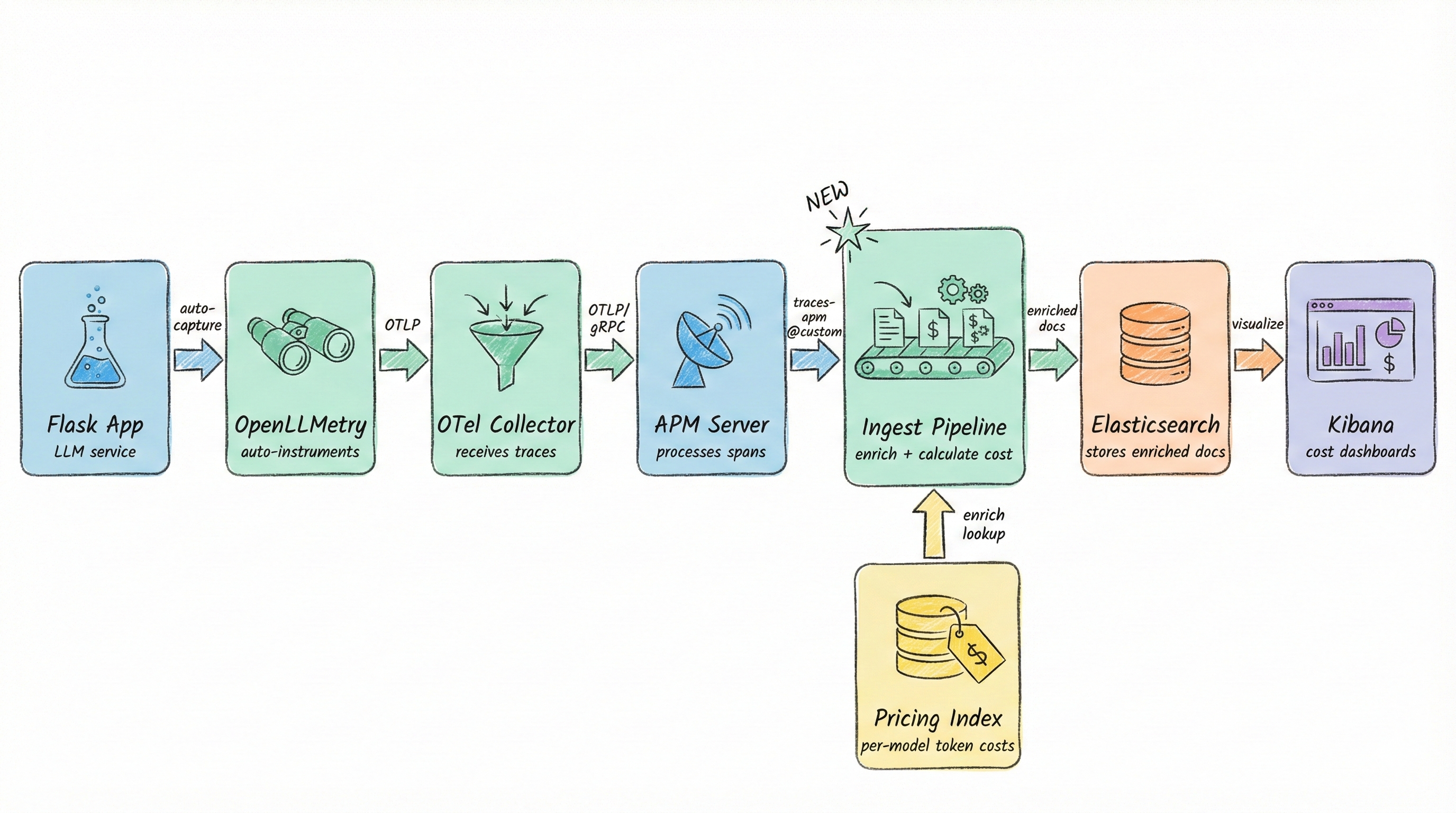
The data flow is the same as the original post’s architecture (Flask App → OpenLLMetry SDK → OTel Collector → APM Server → Elasticsearch → Kibana), with one addition: an ingest pipeline sits between APM Server and Elasticsearch, performing a pricing lookup before the document is indexed.
Three components make this work:
- Pricing source index (
llm-pricing): stores per-model token pricing as regular Elasticsearch documents. - Enrich policy (
llm-pricing-policy): creates a read-only, force-merged lookup index from the source. This is what the pipeline queries at ingest time. - Ingest pipeline (
enrich-llm-costs): wired into traces-apm@custom, the official extension point for APM traces. It builds a composite key from provider + model, looks up pricing, calculates cost, and writes the result to numeric_labels.*.
The beauty of this design is that the application code doesn’t change at all. OpenLLMetry already emits token counts. Elasticsearch handles the rest.
3. Step 1 — The Pricing Index#
The pricing index is a plain Elasticsearch index with one document per model:
 1
 2
 3
 4
 5
 6
 7
 8
 9
10
11
12
13
14
| PUT /llm-pricing
{
"mappings": {
"properties": {
"model_id": { "type": "keyword" },
"provider": { "type": "keyword" },
"model_name": { "type": "keyword" },
"input_price_per_million_tokens": { "type": "scaled_float", "scaling_factor": 10000 },
"output_price_per_million_tokens": { "type": "scaled_float", "scaling_factor": 10000 },
"effective_date": { "type": "date" },
"is_current": { "type": "boolean" }
}
}
}
|
A few design decisions worth explaining:
model_id is a composite key: "openai::gpt-4o". This avoids ambiguity when different providers have similarly named models.keyword type is mandatory for the match field. The enrich processor uses a term query internally. A text field will silently fail to match. This is the number-one gotcha I see in forum posts.scaled_float for pricing avoids floating-point precision issues in aggregations. With scaling_factor: 10000, you get four decimal places of precision. More than enough for token pricing.is_current + effective_date enable versioned pricing. When a price changes, set the old doc’s is_current to false and index a new doc with is_current: true. The enrich policy’s query filter ensures only current prices are used in lookups.
The LiteLLM pricing database (the same source the original post’s LiteLLMPricingDatabase class uses) can seed this index. Export what you need and bulk-index it.
Sample data for four models:
1
2
3
4
5
6
7
8
9
| POST /llm-pricing/_bulk
{"index": {"_id": "openai::gpt-4o"}}
{"model_id": "openai::gpt-4o", "provider": "openai", "model_name": "gpt-4o", "input_price_per_million_tokens": 2.50, "output_price_per_million_tokens": 10.00, "effective_date": "2025-01-01", "is_current": true}
{"index": {"_id": "openai::gpt-4o-mini"}}
{"model_id": "openai::gpt-4o-mini", "provider": "openai", "model_name": "gpt-4o-mini", "input_price_per_million_tokens": 0.15, "output_price_per_million_tokens": 0.60, "effective_date": "2025-01-01", "is_current": true}
{"index": {"_id": "anthropic::claude-sonnet-4-20250514"}}
{"model_id": "anthropic::claude-sonnet-4-20250514", "provider": "anthropic", "model_name": "claude-sonnet-4-20250514", "input_price_per_million_tokens": 3.00, "output_price_per_million_tokens": 15.00, "effective_date": "2025-01-01", "is_current": true}
{"index": {"_id": "anthropic::claude-haiku-4-5-20251001"}}
{"model_id": "anthropic::claude-haiku-4-5-20251001", "provider": "anthropic", "model_name": "claude-haiku-4-5-20251001", "input_price_per_million_tokens": 0.80, "output_price_per_million_tokens": 4.00, "effective_date": "2025-01-01", "is_current": true}
|
Tip: Use _id matching the model_id value so you can upsert pricing updates with a simple PUT /llm-pricing/_doc/openai::gpt-4o.
4. Step 2 — The Enrich Policy#
The enrich policy tells Elasticsearch how to build the lookup index:
 1
 2
 3
 4
 5
 6
 7
 8
 9
10
11
12
13
14
15
16
| PUT /_enrich/policy/llm-pricing-policy
{
"match": {
"indices": "llm-pricing",
"match_field": "model_id",
"enrich_fields": [
"provider", "model_name",
"input_price_per_million_tokens",
"output_price_per_million_tokens",
"effective_date"
],
"query": {
"term": { "is_current": true }
}
}
}
|
Then execute it to build the lookup index:
POST /_enrich/policy/llm-pricing-policy/_execute
What happens under the hood: Execution creates a .enrich-llm-pricing-policy-<timestamp> system index: a force-merged, single-segment, read-only index optimized for fast term lookups. The old .enrich-* index stays active until the new one is ready (no downtime during re-execution). Cleanup of old .enrich-* indices runs every 15 minutes by default.
Note: Enrich policies are immutable. To change the field list or match field, you must delete the policy (DELETE /_enrich/policy/llm-pricing-policy) and recreate it. Updating the source data and re-executing is fine. Only structural changes require deletion.
Two other things to know:
- The
query filter is optional but recommended for versioned pricing. Without it, every document in the source index would be included in the lookup, and you’d get unpredictable results when multiple price versions exist for the same model. max_matches defaults to 1, which returns an object. Setting it >1 returns an array. For pricing lookups, 1 is correct.
5. Step 3 — The Ingest Pipeline#
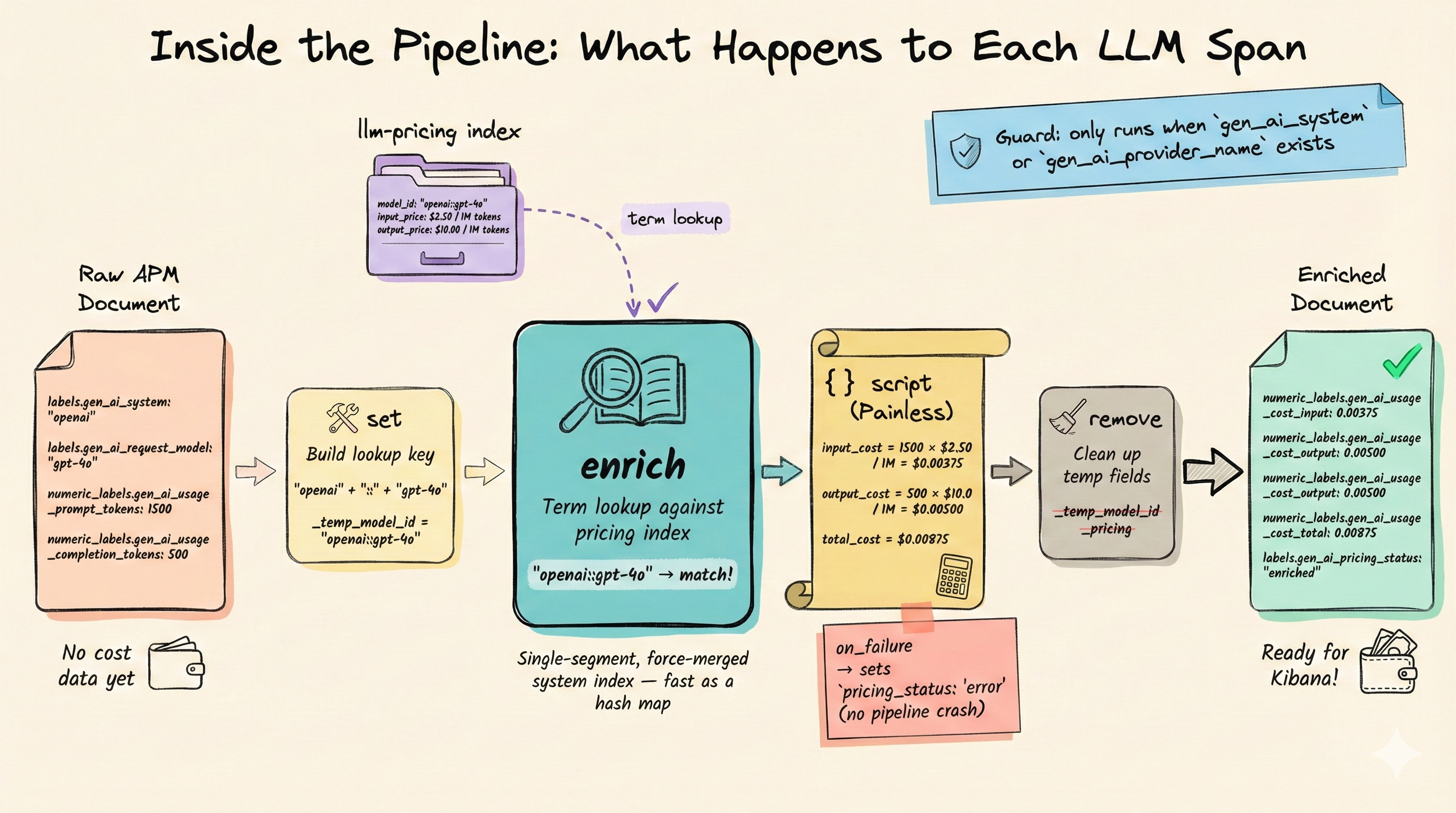
This is the core of the setup. Before showing the pipeline, two things you need to know about how Elastic APM stores OpenTelemetry attributes:
The dot-to-underscore conversion. OpenTelemetry attributes like gen_ai.usage.prompt_tokens are stored in Elasticsearch as numeric_labels.gen_ai_usage_prompt_tokens (if numeric) or labels.gen_ai_usage_prompt_tokens (if string). Dots become underscores. This conversion happens in the default APM pipeline before @custom runs, so the underscore form is what’s available in our pipeline. See the Elastic APM OTel attributes docs.
The OpenTelemetry semantic convention rename. As of OTel semconv v1.38.0, gen_ai.system is deprecated in favor of gen_ai.provider.name, and gen_ai.usage.prompt_tokens / gen_ai.usage.completion_tokens are deprecated in favor of gen_ai.usage.input_tokens / gen_ai.usage.output_tokens. OpenLLMetry still emits the older names as of early 2026. The pipeline handles both.
The complete pipeline:
  1
  2
  3
  4
  5
  6
  7
  8
  9
 10
 11
 12
 13
 14
 15
 16
 17
 18
 19
 20
 21
 22
 23
 24
 25
 26
 27
 28
 29
 30
 31
 32
 33
 34
 35
 36
 37
 38
 39
 40
 41
 42
 43
 44
 45
 46
 47
 48
 49
 50
 51
 52
 53
 54
 55
 56
 57
 58
 59
 60
 61
 62
 63
 64
 65
 66
 67
 68
 69
 70
 71
 72
 73
 74
 75
 76
 77
 78
 79
 80
 81
 82
 83
 84
 85
 86
 87
 88
 89
 90
 91
 92
 93
 94
 95
 96
 97
 98
 99
100
101
102
103
104
105
106
107
108
109
110
111
112
113
114
115
116
117
118
119
120
121
122
123
124
125
126
127
| PUT _ingest/pipeline/enrich-llm-costs
{
"description": "Look up LLM model pricing and calculate per-span costs",
"processors": [
{
"set": {
"tag": "build-model-id",
"description": "Build composite lookup key from provider + model",
"if": """
(ctx?.labels?.gen_ai_system != null || ctx?.labels?.gen_ai_provider_name != null) &&
ctx?.labels?.gen_ai_request_model != null
""",
"field": "_temp_model_id",
"value": "{{labels.gen_ai_system}}::{{labels.gen_ai_request_model}}",
"override": true
}
},
{
"set": {
"tag": "build-model-id-new-convention",
"description": "Handle newer gen_ai.provider.name convention",
"if": "ctx?._temp_model_id == null && ctx?.labels?.gen_ai_provider_name != null && ctx?.labels?.gen_ai_request_model != null",
"field": "_temp_model_id",
"value": "{{labels.gen_ai_provider_name}}::{{labels.gen_ai_request_model}}",
"override": true
}
},
{
"enrich": {
"tag": "lookup-pricing",
"description": "Look up per-token pricing from the llm-pricing index",
"policy_name": "llm-pricing-policy",
"field": "_temp_model_id",
"target_field": "_pricing",
"max_matches": 1,
"ignore_missing": true,
"ignore_failure": true
}
},
{
"set": {
"tag": "flag-missing-pricing",
"description": "Flag spans where no pricing data was found",
"if": "ctx?._temp_model_id != null && ctx?._pricing == null",
"field": "labels.gen_ai_pricing_status",
"value": "not_found"
}
},
{
"script": {
"tag": "calculate-cost",
"description": "Calculate input, output, and total cost from token counts and pricing",
"if": "ctx?._pricing != null",
"lang": "painless",
"source": """
// Helper: extract token count from numeric_labels (preferred) or labels (fallback)
double getTokens(def ctx, String fieldName) {
if (ctx.numeric_labels != null && ctx.numeric_labels.containsKey(fieldName)) {
return ((Number) ctx.numeric_labels[fieldName]).doubleValue();
}
if (ctx.labels != null && ctx.labels.containsKey(fieldName)) {
try {
return Double.parseDouble(ctx.labels[fieldName].toString());
} catch (NumberFormatException e) {
return 0.0;
}
}
return 0.0;
}
// Handle both old (prompt_tokens/completion_tokens) and new (input_tokens/output_tokens) conventions
double promptTokens = getTokens(ctx, 'gen_ai_usage_prompt_tokens');
if (promptTokens == 0.0) {
promptTokens = getTokens(ctx, 'gen_ai_usage_input_tokens');
}
double completionTokens = getTokens(ctx, 'gen_ai_usage_completion_tokens');
if (completionTokens == 0.0) {
completionTokens = getTokens(ctx, 'gen_ai_usage_output_tokens');
}
// Get pricing from the enrich lookup
double inputPrice = ((Number) ctx._pricing.input_price_per_million_tokens).doubleValue();
double outputPrice = ((Number) ctx._pricing.output_price_per_million_tokens).doubleValue();
// Calculate costs
double inputCost = promptTokens * inputPrice / 1_000_000.0;
double outputCost = completionTokens * outputPrice / 1_000_000.0;
double totalCost = inputCost + outputCost;
// Write to numeric_labels so Kibana can aggregate numerically
if (ctx.numeric_labels == null) { ctx.numeric_labels = new HashMap(); }
ctx.numeric_labels.put('gen_ai_usage_cost_input', inputCost);
ctx.numeric_labels.put('gen_ai_usage_cost_output', outputCost);
ctx.numeric_labels.put('gen_ai_usage_cost_total', totalCost);
// Write pricing status to labels
if (ctx.labels == null) { ctx.labels = new HashMap(); }
ctx.labels.put('gen_ai_pricing_status', 'enriched');
ctx.labels.put('gen_ai_pricing_model_resolved', ctx._pricing.model_name);
""",
"on_failure": [
{
"set": {
"field": "labels.gen_ai_pricing_status",
"value": "error"
}
},
{
"set": {
"field": "labels.gen_ai_pricing_error",
"value": "{{_ingest.on_failure_message}}"
}
}
]
}
},
{
"remove": {
"tag": "cleanup-temp-fields",
"description": "Remove temporary fields used during enrichment",
"field": ["_temp_model_id", "_pricing"],
"ignore_missing": true
}
}
]
}
|
Then wire it into the APM custom pipeline:
 1
 2
 3
 4
 5
 6
 7
 8
 9
10
11
12
13
| PUT _ingest/pipeline/traces-apm@custom
{
"description": "Custom processing for APM traces: LLM cost enrichment",
"processors": [
{
"pipeline": {
"name": "enrich-llm-costs",
"if": "ctx?.labels?.gen_ai_system != null || ctx?.labels?.gen_ai_provider_name != null",
"ignore_failure": true
}
}
]
}
|
The if condition is a performance guard. The cost pipeline only fires for LLM spans (those with a gen_ai.system or gen_ai.provider.name attribute). All other APM traces pass through untouched.
Production safety: If you’re on Elastic 8.12.0, the traces-apm@custom pipeline is invoked twice due to a naming collision between ${type}-${package}@custom and ${type}-${dataset}@custom. This is fixed in 8.12.1. See Kibana #175254. The double invocation won’t corrupt data (costs are recalculated, not accumulated), but it wastes resources. Upgrade if you can.
A few Painless scripting notes for anyone modifying the script:
((Number) nVal).doubleValue(): numeric_labels values arrive as boxed Java numbers (could be Long, Integer, or Double). Casting to Number first handles all cases.Double.parseDouble() is needed for string-typed tokens that land in labels.* instead of numeric_labels.*.- The
?. null-safe operator prevents NPE when navigating nested maps, but method calls on null-safe results are NOT safe. ctx.network?.name.equalsIgnoreCase('x') throws NPE if name is null. - The
on_failure block captures errors per-span without failing the entire pipeline. You can query for labels.gen_ai_pricing_status: "error" in Kibana to find broken spans.
6. Testing with the Simulate API#
Before deploying, test the pipeline with the _simulate API. This hits the live .enrich-* index, so the policy must be created and executed first.
 1
 2
 3
 4
 5
 6
 7
 8
 9
10
11
12
13
14
15
16
17
18
19
20
21
22
23
24
25
26
27
28
29
30
31
32
33
34
35
36
37
38
39
40
41
42
43
44
45
46
47
48
49
50
51
52
53
| POST _ingest/pipeline/enrich-llm-costs/_simulate?verbose
{
"docs": [
{
"_index": "traces-apm-default",
"_source": {
"labels": {
"gen_ai_system": "openai",
"gen_ai_request_model": "gpt-4o"
},
"numeric_labels": {
"gen_ai_usage_prompt_tokens": 1500,
"gen_ai_usage_completion_tokens": 500
}
}
},
{
"_index": "traces-apm-default",
"_source": {
"labels": {
"gen_ai_system": "anthropic",
"gen_ai_request_model": "claude-sonnet-4-20250514"
},
"numeric_labels": {
"gen_ai_usage_prompt_tokens": 800,
"gen_ai_usage_completion_tokens": 1200
}
}
},
{
"_index": "traces-apm-default",
"_source": {
"labels": {
"gen_ai_system": "openai",
"gen_ai_request_model": "unknown-model-xyz"
},
"numeric_labels": {
"gen_ai_usage_prompt_tokens": 100,
"gen_ai_usage_completion_tokens": 50
}
}
},
{
"_index": "traces-apm-default",
"_source": {
"span": {
"type": "db",
"subtype": "postgresql"
}
}
}
]
}
|
Each test doc validates a different scenario:
- OpenAI GPT-4o (happy path). Should calculate: input cost = 1500 × $2.50/1M = $0.00375, output cost = 500 × $10.00/1M = $0.005, total = $0.00875.
- Anthropic Claude (cross-provider lookup). Verifies the composite key
anthropic::claude-sonnet-4-20250514 resolves correctly. - Unknown model: should get
gen_ai_pricing_status: "not_found", no crash, no cost fields. This is your signal to add the model to the pricing index. - Non-LLM span (a PostgreSQL database span). Should pass through completely untouched, with no
_temp_model_id, no _pricing, no cost fields.
Tip: Elastic 8.12+ also offers POST /_ingest/_simulate, which can simulate the entire pipeline chain including default and final pipelines for a given data stream. Useful if you want to test the full traces-apm@custom wiring.
7. Updating Pricing#
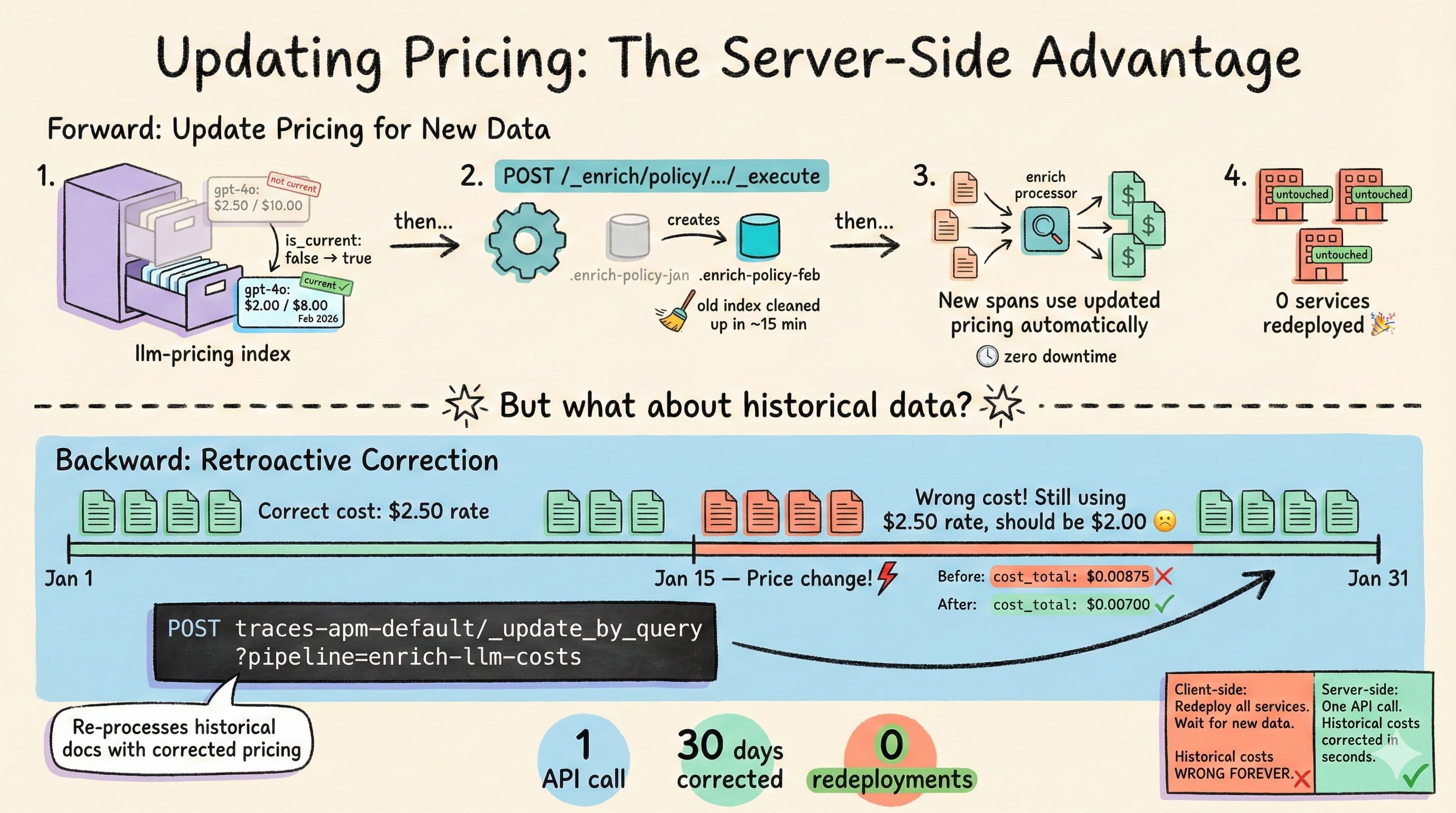
This is where the server-side approach really pays off. When model pricing changes:
Step 1 — Update the source index:
 1
 2
 3
 4
 5
 6
 7
 8
 9
10
11
12
13
14
15
| // Mark old price as not current
POST /llm-pricing/_update/openai::gpt-4o
{ "doc": { "is_current": false } }
// Index new price
PUT /llm-pricing/_doc/openai::gpt-4o-2026-02
{
"model_id": "openai::gpt-4o",
"provider": "openai",
"model_name": "gpt-4o",
"input_price_per_million_tokens": 2.00,
"output_price_per_million_tokens": 8.00,
"effective_date": "2026-02-01",
"is_current": true
}
|
Step 2 — Re-execute the policy:
POST /_enrich/policy/llm-pricing-policy/_execute
Step 3 — Future documents use the new pricing immediately. No redeployment needed.
Retroactive Corrections#
This is the feature that’s impossible with client-side enrichment. If you discover that pricing was wrong for the past month, you can re-process historical documents:
 1
 2
 3
 4
 5
 6
 7
 8
 9
10
11
| POST traces-apm-default/_update_by_query?pipeline=enrich-llm-costs
{
"query": {
"bool": {
"must": [
{ "exists": { "field": "labels.gen_ai_system" } },
{ "range": { "@timestamp": { "gte": "2026-02-01" } } }
]
}
}
}
|
_update_by_query rewrites documents in place. On large indices this can be slow and resource-intensive. Use the size and scroll_size parameters to throttle, and consider running during off-peak hours.
Automating Policy Re-Execution#
There’s no built-in scheduling for enrich policy re-execution. GitHub issue elastic/elasticsearch#50071 is still open. Your options:
- Cron job (recommended for most teams):
curl -X POST "https://es-host:9200/_enrich/policy/llm-pricing-policy/_execute" on a daily or weekly schedule. - Elasticsearch Watcher: works but requires configuring auth in the Watcher action.
- CI/CD trigger: re-execute as part of a pricing update deployment script. Good for teams that already manage pricing in version control.
8. What Changes in Your Application Code#
This is the payoff.
Before (from the original post):
1
2
3
4
5
| from traceloop.sdk import Traceloop
from llm_cost_injector import inject_llm_cost_tracking
Traceloop.init(app_name="recipe-generator-service", ...)
inject_llm_cost_tracking() # Wraps the exporter, loads pricing
|
After:
1
2
3
4
| from traceloop.sdk import Traceloop
Traceloop.init(app_name="recipe-generator-service", ...)
# That's it. Cost enrichment happens in Elasticsearch.
|
The entire llm_cost_injector.py file (200+ lines), the LiteLLMPricingDatabase class, and the exporter wrapping logic are all deleted. The application emits token counts (which OpenLLMetry does automatically), and Elasticsearch handles the rest.
If you have multiple services in different languages (a Python backend, a Node.js gateway, a Java batch processor), they all get cost enrichment for free. No per-language reimplementation.
9. Dashboard Compatibility#
If your existing dashboards query numeric_labels.gen_ai_cost_total_usd (the field name from the original post’s CostEnrichingSpanExporter), you’ll need to update the field references. The ingest pipeline writes to slightly different field names:
| Original Post (Client-Side) | This Post (Server-Side) |
|---|
numeric_labels.gen_ai_cost_total_usd | numeric_labels.gen_ai_usage_cost_total |
numeric_labels.gen_ai_cost_input_usd | numeric_labels.gen_ai_usage_cost_input |
numeric_labels.gen_ai_cost_output_usd | numeric_labels.gen_ai_usage_cost_output |
labels.gen_ai_cost_model_resolved | labels.gen_ai_pricing_model_resolved |
| N/A | labels.gen_ai_pricing_status |
Update your Kibana Lens formulas accordingly:
- Total spend:
sum(numeric_labels.gen_ai_usage_cost_total) - Input cost:
sum(numeric_labels.gen_ai_usage_cost_input) - Output cost:
sum(numeric_labels.gen_ai_usage_cost_output) - Per-model breakdown: split by
labels.gen_ai_request_model - Missing pricing alert: filter on
labels.gen_ai_pricing_status: "not_found"
numeric_labels.* fields support numeric aggregations (sum, avg, percentiles) in Kibana Lens. Fields under labels.* only support term-based aggregations. This is why costs go into numeric_labels and status strings go into labels.
10. Putting It All Together#
The end-to-end setup script below ties everything together. Save it and run it against your Elasticsearch cluster:
  1
  2
  3
  4
  5
  6
  7
  8
  9
 10
 11
 12
 13
 14
 15
 16
 17
 18
 19
 20
 21
 22
 23
 24
 25
 26
 27
 28
 29
 30
 31
 32
 33
 34
 35
 36
 37
 38
 39
 40
 41
 42
 43
 44
 45
 46
 47
 48
 49
 50
 51
 52
 53
 54
 55
 56
 57
 58
 59
 60
 61
 62
 63
 64
 65
 66
 67
 68
 69
 70
 71
 72
 73
 74
 75
 76
 77
 78
 79
 80
 81
 82
 83
 84
 85
 86
 87
 88
 89
 90
 91
 92
 93
 94
 95
 96
 97
 98
 99
100
101
102
103
104
105
106
107
108
109
110
111
112
113
114
115
116
117
118
119
120
121
122
123
124
125
126
127
128
129
130
131
132
133
134
135
136
137
138
139
140
141
142
143
144
145
146
147
148
149
150
151
152
153
154
155
| #!/bin/bash
# setup-llm-cost-pipeline.sh
# Sets up server-side LLM cost enrichment via Elasticsearch ingest pipelines.
# Requires: curl, a running Elasticsearch cluster.
# Usage: ES_HOST=http://localhost:9200 ES_AUTH=elastic:changeme ./setup-llm-cost-pipeline.sh
set -euo pipefail
ES_HOST="${ES_HOST:-http://localhost:9200}"
ES_AUTH="${ES_AUTH:-elastic:changeme}"
echo "=== LLM Cost Enrichment Pipeline Setup ==="
echo "Target: $ES_HOST"
echo ""
# 1. Create pricing index
echo "1/6 Creating pricing index..."
curl -sf -u "$ES_AUTH" -X PUT "$ES_HOST/llm-pricing" \
-H 'Content-Type: application/json' -d '{
"mappings": {
"properties": {
"model_id": { "type": "keyword" },
"provider": { "type": "keyword" },
"model_name": { "type": "keyword" },
"input_price_per_million_tokens": { "type": "scaled_float", "scaling_factor": 10000 },
"output_price_per_million_tokens": { "type": "scaled_float", "scaling_factor": 10000 },
"effective_date": { "type": "date" },
"is_current": { "type": "boolean" }
}
}
}' && echo " OK" || echo " (already exists)"
# 2. Load pricing data
echo "2/6 Loading pricing data..."
curl -sf -u "$ES_AUTH" -X POST "$ES_HOST/llm-pricing/_bulk" \
-H 'Content-Type: application/json' -d '
{"index": {"_id": "openai::gpt-4o"}}
{"model_id": "openai::gpt-4o", "provider": "openai", "model_name": "gpt-4o", "input_price_per_million_tokens": 2.50, "output_price_per_million_tokens": 10.00, "effective_date": "2025-01-01", "is_current": true}
{"index": {"_id": "openai::gpt-4o-mini"}}
{"model_id": "openai::gpt-4o-mini", "provider": "openai", "model_name": "gpt-4o-mini", "input_price_per_million_tokens": 0.15, "output_price_per_million_tokens": 0.60, "effective_date": "2025-01-01", "is_current": true}
{"index": {"_id": "anthropic::claude-sonnet-4-20250514"}}
{"model_id": "anthropic::claude-sonnet-4-20250514", "provider": "anthropic", "model_name": "claude-sonnet-4-20250514", "input_price_per_million_tokens": 3.00, "output_price_per_million_tokens": 15.00, "effective_date": "2025-01-01", "is_current": true}
{"index": {"_id": "anthropic::claude-haiku-4-5-20251001"}}
{"model_id": "anthropic::claude-haiku-4-5-20251001", "provider": "anthropic", "model_name": "claude-haiku-4-5-20251001", "input_price_per_million_tokens": 0.80, "output_price_per_million_tokens": 4.00, "effective_date": "2025-01-01", "is_current": true}
' && echo " OK"
# 3. Create enrich policy
echo "3/6 Creating enrich policy..."
curl -sf -u "$ES_AUTH" -X PUT "$ES_HOST/_enrich/policy/llm-pricing-policy" \
-H 'Content-Type: application/json' -d '{
"match": {
"indices": "llm-pricing",
"match_field": "model_id",
"enrich_fields": [
"provider", "model_name",
"input_price_per_million_tokens",
"output_price_per_million_tokens",
"effective_date"
],
"query": {
"term": { "is_current": true }
}
}
}' && echo " OK"
# 4. Execute enrich policy
echo "4/6 Executing enrich policy (building lookup index)..."
curl -sf -u "$ES_AUTH" -X POST \
"$ES_HOST/_enrich/policy/llm-pricing-policy/_execute" && echo " OK"
# 5. Create enrichment pipeline
echo "5/6 Creating enrichment pipeline..."
curl -sf -u "$ES_AUTH" -X PUT "$ES_HOST/_ingest/pipeline/enrich-llm-costs" \
-H 'Content-Type: application/json' -d '{
"description": "Look up LLM model pricing and calculate per-span costs",
"processors": [
{
"set": {
"tag": "build-model-id",
"if": "(ctx?.labels?.gen_ai_system != null || ctx?.labels?.gen_ai_provider_name != null) && ctx?.labels?.gen_ai_request_model != null",
"field": "_temp_model_id",
"value": "{{labels.gen_ai_system}}::{{labels.gen_ai_request_model}}",
"override": true
}
},
{
"set": {
"tag": "build-model-id-new-convention",
"if": "ctx?._temp_model_id == null && ctx?.labels?.gen_ai_provider_name != null && ctx?.labels?.gen_ai_request_model != null",
"field": "_temp_model_id",
"value": "{{labels.gen_ai_provider_name}}::{{labels.gen_ai_request_model}}",
"override": true
}
},
{
"enrich": {
"tag": "lookup-pricing",
"policy_name": "llm-pricing-policy",
"field": "_temp_model_id",
"target_field": "_pricing",
"max_matches": 1,
"ignore_missing": true,
"ignore_failure": true
}
},
{
"set": {
"tag": "flag-missing-pricing",
"if": "ctx?._temp_model_id != null && ctx?._pricing == null",
"field": "labels.gen_ai_pricing_status",
"value": "not_found"
}
},
{
"script": {
"tag": "calculate-cost",
"if": "ctx?._pricing != null",
"lang": "painless",
"source": "double getTokens(def ctx, String fieldName) { if (ctx.numeric_labels != null && ctx.numeric_labels.containsKey(fieldName)) { return ((Number) ctx.numeric_labels[fieldName]).doubleValue(); } if (ctx.labels != null && ctx.labels.containsKey(fieldName)) { try { return Double.parseDouble(ctx.labels[fieldName].toString()); } catch (NumberFormatException e) { return 0.0; } } return 0.0; } double promptTokens = getTokens(ctx, '"'"'gen_ai_usage_prompt_tokens'"'"'); if (promptTokens == 0.0) { promptTokens = getTokens(ctx, '"'"'gen_ai_usage_input_tokens'"'"'); } double completionTokens = getTokens(ctx, '"'"'gen_ai_usage_completion_tokens'"'"'); if (completionTokens == 0.0) { completionTokens = getTokens(ctx, '"'"'gen_ai_usage_output_tokens'"'"'); } double inputPrice = ((Number) ctx._pricing.input_price_per_million_tokens).doubleValue(); double outputPrice = ((Number) ctx._pricing.output_price_per_million_tokens).doubleValue(); double inputCost = promptTokens * inputPrice / 1000000.0; double outputCost = completionTokens * outputPrice / 1000000.0; double totalCost = inputCost + outputCost; if (ctx.numeric_labels == null) { ctx.numeric_labels = new HashMap(); } ctx.numeric_labels.put('"'"'gen_ai_usage_cost_input'"'"', inputCost); ctx.numeric_labels.put('"'"'gen_ai_usage_cost_output'"'"', outputCost); ctx.numeric_labels.put('"'"'gen_ai_usage_cost_total'"'"', totalCost); if (ctx.labels == null) { ctx.labels = new HashMap(); } ctx.labels.put('"'"'gen_ai_pricing_status'"'"', '"'"'enriched'"'"'); ctx.labels.put('"'"'gen_ai_pricing_model_resolved'"'"', ctx._pricing.model_name);",
"on_failure": [
{ "set": { "field": "labels.gen_ai_pricing_status", "value": "error" } },
{ "set": { "field": "labels.gen_ai_pricing_error", "value": "{{_ingest.on_failure_message}}" } }
]
}
},
{
"remove": {
"tag": "cleanup-temp-fields",
"field": ["_temp_model_id", "_pricing"],
"ignore_missing": true
}
}
]
}' && echo " OK"
# 6. Wire into APM custom pipeline
echo "6/6 Wiring into traces-apm@custom..."
curl -sf -u "$ES_AUTH" -X PUT "$ES_HOST/_ingest/pipeline/traces-apm@custom" \
-H 'Content-Type: application/json' -d '{
"description": "Custom processing for APM traces: LLM cost enrichment",
"processors": [
{
"pipeline": {
"name": "enrich-llm-costs",
"if": "ctx?.labels?.gen_ai_system != null || ctx?.labels?.gen_ai_provider_name != null",
"ignore_failure": true
}
}
]
}' && echo " OK"
echo ""
echo "=== Setup complete ==="
echo "LLM cost enrichment is now active for all APM traces."
echo "Test with: POST _ingest/pipeline/enrich-llm-costs/_simulate?verbose"
|
The setup script and all pipeline configs are available in the companion repo under elasticsearch/.
Conclusion#
We moved from ~200 lines of fragile Python (wrapping a private _attributes API, bundling a pricing database, redeploying to update prices) to ~50 lines of Elasticsearch configuration that handles all of it server-side.
The pricing index is your single source of truth. Update it once, re-execute the policy, and every service that emits LLM traces gets the new pricing automatically. If you discover a pricing error from last month, _update_by_query corrects the historical data. And OpenTelemetry spans stay immutable, exactly as the spec intended.
The tradeoff is real: you now have Elasticsearch infrastructure to manage (an enrich policy, a pipeline, a pricing index). For a team that already runs Elastic, this is a natural fit. For a quick prototype, the client-side approach from the original post is simpler.
Cost math vs invoice reality: The same caveat applies. Token-based estimates can differ from provider billing due to system prompts, cached tokens, tool call overhead, tiered pricing, and rounding. Treat this as an allocation and monitoring signal, not a perfect invoice replica.
Check out the companion repo for the full source code, and the original post for the end-to-end monitoring setup this builds on.